
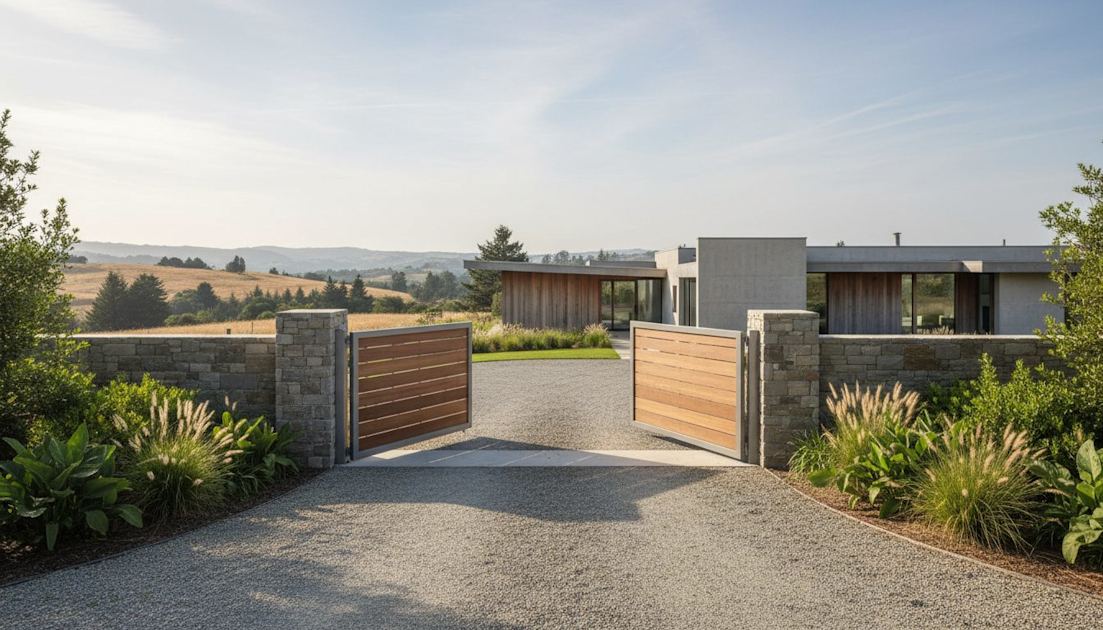


Choosing the right driveway gate is a critical decision for your property’s security, aesthetics, and daily convenience. This guide, from your licensed Sacramento-area gate experts at DC Controls, will equip you with the practical knowledge to understand the fundamental differences between sliding and swing gates, detailing their unique advantages, drawbacks, and the essential factors that determine which system is best for your home or business. We’ll cover everything from space requirements and security features to installation complexities, safety standards, and real-world cost considerations, ensuring you make an informed choice that stands the test of time.
Sliding Gate vs. Swing Gate for Driveways: The Core Differences
The fundamental distinction between a sliding gate and a swing gate lies in their operational mechanics and the space they require. A sliding gate moves horizontally, parallel to your fence line, while a swing gate pivots on hinges, opening inward or outward in an arc like a traditional door. Understanding these core movements is the first step in determining which gate type suits your driveway.
Sliding Gates: Space-Saving and Secure
Sliding gates are an excellent choice when driveway space is at a premium or when dealing with sloped terrain. Instead of arcing, they glide open, requiring a clear, linear path along the fence or wall adjacent to the driveway. This operational style makes them particularly suitable for properties where the driveway immediately inclines, declines, or meets a building, preventing a swing gate from opening.
There are two primary types of sliding gates:
- V-Track Sliding Gates: These gates ride on a wheel system along a V-shaped track embedded in the driveway or a concrete pad. They are typically more straightforward and less expensive to install than cantilever gates. However, the track must be kept clear of debris like leaves, dirt, or snow, which can impede operation. In Sacramento’s Central Valley, dust and fallen foliage can be a common concern, necessitating regular track cleaning.
- Cantilever Sliding Gates: These gates are suspended above the ground, supported by a series of rollers mounted on posts. They “cantilever” or extend over the driveway opening without touching the ground or requiring a track across the drive itself. This design eliminates ground debris issues and is ideal for uneven surfaces or areas with heavy snow, though less common for snow in Sacramento. Cantilever systems are more complex to engineer and install, requiring a longer gate panel (typically 1.5 times the opening width) and robust support structures, which increases cost.
Pros of Sliding Gates:
- Space Efficiency: Does not require a large clear arc, ideal for short driveways or those opening directly onto busy streets.
- Security: Generally considered more secure as they are harder to force open, especially when fully closed and engaged with a positive stop.
- Slope Tolerance: Excellent for driveways with significant inclines or declines where swing gates are impractical.
- Wind Resistance: Less susceptible to wind damage compared to large swing gates, as they are often more rigidly supported.
Cons of Sliding Gates:
- Linear Space Requirement: Needs a long, clear fence line or wall for the gate to slide along, typically 1.5 times the width of the driveway opening for cantilever gates.
- Debris Issues (V-Track): Ground tracks can accumulate dirt, leaves, and small stones, requiring regular cleaning to prevent operational issues.
- Installation Complexity: Cantilever systems, while robust, are more intricate to design and install correctly.
- Cost: Often higher initial installation costs, particularly for cantilever systems.
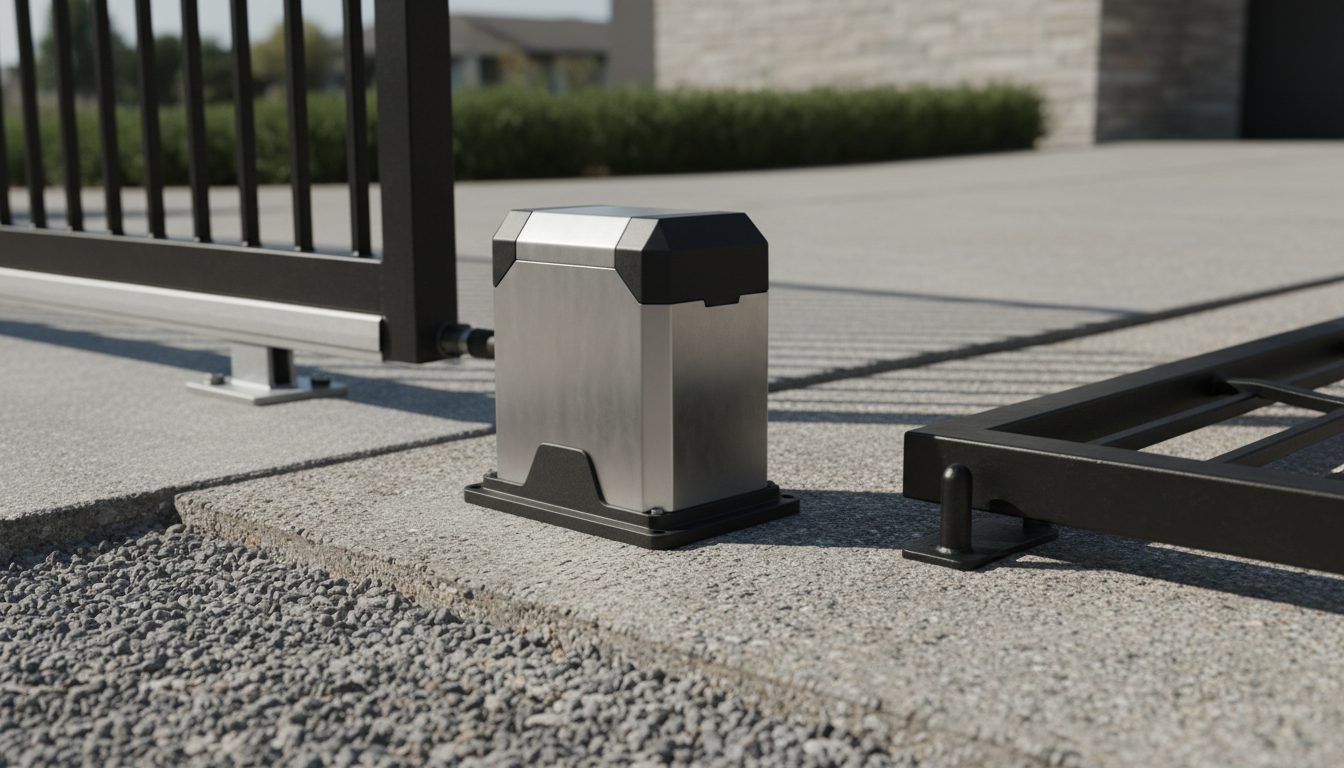
Popular sliding gate operators we install include the LiftMaster Mega Slide and SL3000UL, the heavy-duty HySecurity SlideDriver, and various models from DoorKing, Viking Access, and FAAC.
Swing Gates: Classic Aesthetics and Simplicity
Swing gates offer a timeless, traditional aesthetic that can significantly enhance a property’s curb appeal. They operate by pivoting on hinges, opening either as a single large leaf or as two smaller bi-parting leaves. This classic motion is often preferred for its elegant appearance and can be visually grand, especially with custom designs.
Pros of Swing Gates:
- Aesthetics: Offers a classic, elegant look, easily integrated into various architectural styles.
- Simpler Mechanics: Generally fewer moving parts than sliding gates, potentially leading to lower initial installation costs for the gate itself.
- Less Ground Interference: No ground track to keep clean, making them less susceptible to debris.
- Emergency Egress: Many swing gate operators (like the LiftMaster LA500 and LA412) have a built-in manual release for quick exit during power outages.
Cons of Swing Gates:
- Space Requirement: Demands significant clear space (the full width of the gate leaf) for the gate to swing open, both inward or outward. This is a major limitation for short driveways or those opening onto public sidewalks/streets.
- Slope Limitations: Cannot be installed on driveways with a steep uphill slope where the gate would hit the ground as it opens. Can be challenging on downhill slopes as well.
- Wind Vulnerability: Large gate panels can act as sails in high winds, putting stress on hinges and operators, potentially leading to damage.
- “Gate Drag”: On soft ground or with heavy gates, the gate’s weight can cause the bottom edge to drag, especially if foundations settle or hinges sag over time.
For swing gates, we frequently install reliable operators like the LiftMaster LA500UL and LA412UL, the robust DoorKing 9100 and 9150 series, and solutions from Viking Access, Nice/Hy-O, and BFT.
Key Factors Influencing Your Gate Choice
Beyond the basic operational differences, several practical considerations will heavily influence whether a sliding or swing gate is the best fit for your Sacramento-area property. We always assess these factors during our initial site visits.
Available Space and Driveway Slope
This is often the most critical factor.
- For Sliding Gates: You need clear, linear space along a fence or wall equal to or greater than the gate’s total length (which is usually 1.5 times the driveway opening for cantilever systems). If your property has a short frontage or is constrained by buildings, a sliding gate might be your only option. They are also highly adaptable to sloped driveways, as their horizontal movement is unaffected by changes in elevation across the driveway opening itself.
- For Swing Gates: A swing gate requires an unobstructed arc of motion. If your driveway goes uphill immediately after the gate, a swing gate will hit the ground. Similarly, if your driveway opens directly onto a public sidewalk or street, swinging outward could create a hazard and violate local Sacramento codes. Swinging inward requires that you have enough clear space on your property for vehicles to wait safely off the street while the gate opens.
Security and Privacy Considerations
Both gate types, when properly installed and automated, provide a significant boost to security and privacy. However, there are subtle differences:
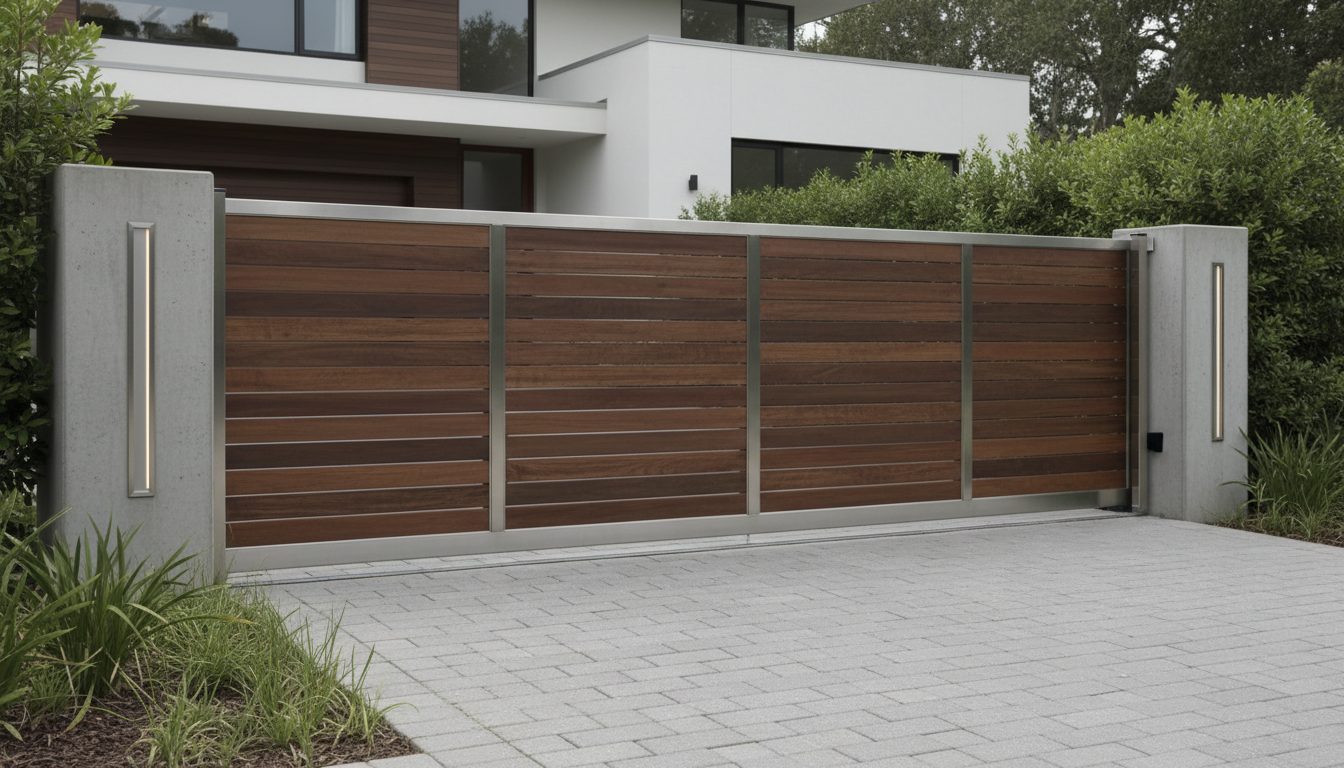
- Sliding gates are generally perceived as more robust and harder to force open due to their continuous engagement with a track or support system along their entire length when closed. They offer a strong physical barrier.
- Swing gates, while secure, rely on hinges and the operator’s locking mechanism. A single large swing gate can sometimes be seen as having a single point of failure (the hinges) if not properly reinforced. However, modern operators like the LiftMaster LA500 come with strong locking capabilities, making forced entry very difficult.
Aesthetic Preferences and Property Style
The visual impact of your gate is undeniable, and each type offers a distinct aesthetic:
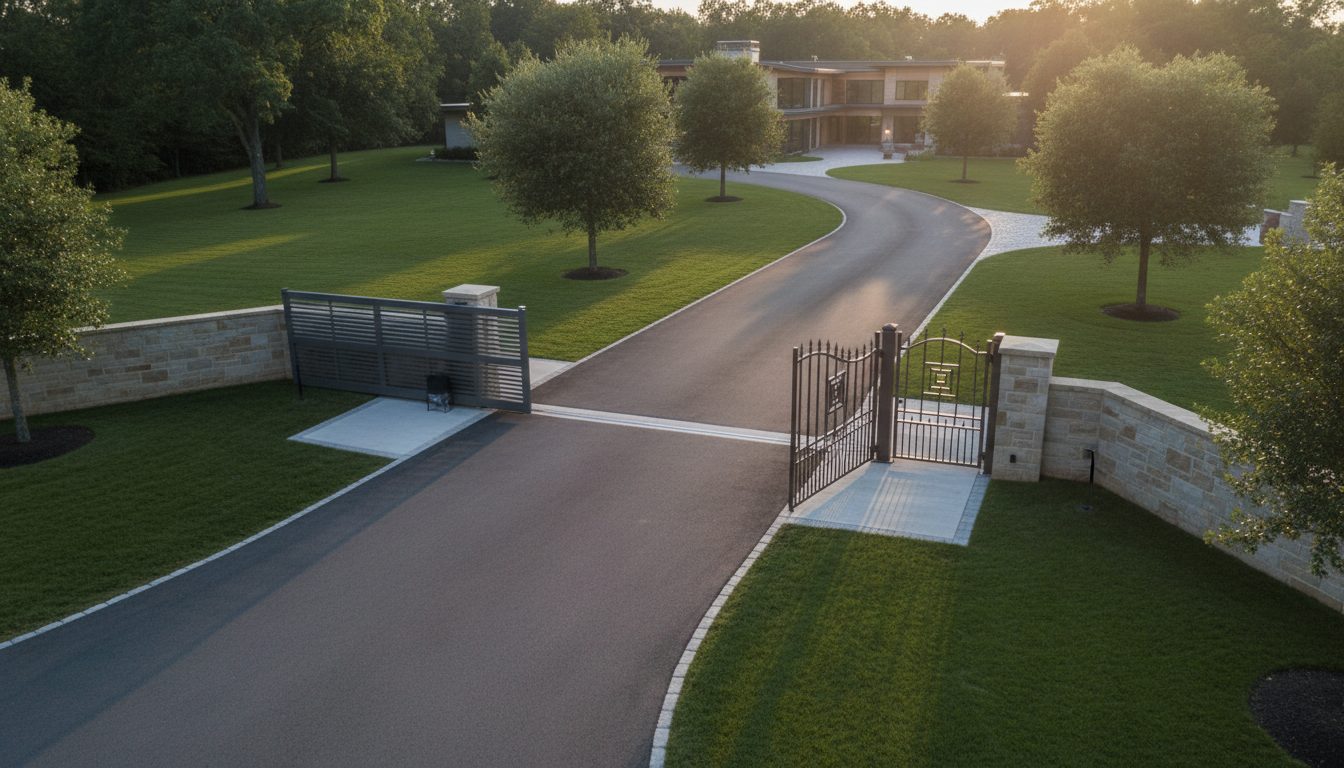
- Swing gates often lend themselves to a more traditional, grand, or classic appearance. Their sweeping motion can be quite elegant, and they are frequently chosen for properties with a more stately or historic feel. Custom designs, often incorporating intricate scrollwork or solid panels, are very popular.
- Sliding gates tend to have a more modern, utilitarian, or minimalist aesthetic. Their linear movement is efficient and can complement contemporary architectural styles. While they can also be highly customized, their design is often driven more by function.
Maintenance and Durability
The long-term upkeep of your gate system is an important consideration:
- Sliding gates (V-track): Require periodic cleaning of the ground track to prevent debris from hindering operation. The wheels and bearings also need inspection and lubrication. Cantilever systems, while more complex initially, typically require less ground-level maintenance.
- Swing gates: Generally have simpler mechanical components (hinges, operator arms). Hinges need lubrication, and the gate’s alignment should be checked regularly, especially for heavy gates. In the Central Valley’s climate, dust and heat can affect all mechanical components, but swing gates are less prone to ground-level debris issues. Wind can also be a significant factor for large swing gates, potentially stressing components.
Installation Complexities, Safety Standards, and Operator Technology
Installing an automatic gate is a complex process that goes far beyond simply hanging a gate. It involves electrical work, concrete pouring, precise alignment, and adherence to strict safety regulations. This is why choosing a licensed contractor like DC Controls (CA C-13 license #1114559) is paramount.
Understanding Gate Operators and Duty Cycles
The gate operator, or motor, is the heart of your automated system. Choosing the right one depends heavily on how often your gate will be used – its duty cycle.
- Duty Cycle Explained: This refers to the number of times a gate can open and close within a specific period (e.g., cycles per hour, or daily cycles). A residential gate used a few times a day has a much lower duty cycle requirement than a commercial gate at an apartment complex or business park that sees hundreds of cycles daily.
- Residential Operators: Brands like LiftMaster (e.g., LA400, LA500 for swing; Mega Slide, SL3000 for slide) and DoorKing (e.g., 9100, 9150 for swing; 9500 for slide) offer robust residential and light-commercial solutions. These are typically DC electromechanical operators, known for their quiet operation and battery backup capabilities.
- Commercial/Industrial Operators: For high-traffic applications, heavy-duty operators are essential. HySecurity (e.g., SlideDriver for slide, StrongArm for barrier arms) is renowned for its AC hydraulic operators, which are built for continuous, heavy-duty cycles in demanding environments. Viking Access, FAAC, BFT, and CAME also offer a range of commercial-grade solutions.
When installing DC operators, especially over longer distances from the power source, we meticulously calculate for voltage drop. Insufficient wire gauge can lead to reduced power, slower operation, and premature operator failure, a common issue we see from inexperienced installers.
Critical Safety Standards: UL 325 and Beyond
Automatic gates, if improperly installed, can pose serious safety risks. That’s why the UL 325 safety standard is non-negotiable for all automated gate systems in the United States. This standard, along with ASTM F2200 for gate construction, dictates essential safety features to prevent entrapment, crushing, and other hazards.
- Primary Entrapment Protection: Every automatic gate must have at least two independent means of entrapment protection. These typically include:
- Photo-eyes (infrared beams): These create an invisible beam across the gate opening. If the beam is broken while the gate is closing, it immediately reverses.
- Sensing Edges: Pressure-sensitive strips mounted on the gate’s leading or trailing edges. If they contact an obstruction, the gate stops or reverses.
- Secondary Entrapment Protection: Built into modern operators, this includes features like inherent obstruction sensing, which detects unusual resistance and stops or reverses the gate.
- Warning Signs: Clearly visible warning signs must be posted.
- Manual Release: All operators must have a safe, easily accessible manual release mechanism for emergencies or power outages.
“Ignoring UL 325 isn’t just a code violation; it’s a direct threat to safety, and sadly, we’ve seen the tragic consequences of non-compliant installations.”
Beyond UL 325, we adhere to CA Title 24 for electrical installations and ensure all necessary local Sacramento permitting is obtained. Unpermitted work can lead to fines, stop-work orders, and significant headaches down the road.
V-Track vs. Cantilever Sliding Gates
When considering a sliding gate, the choice between V-track and cantilever is crucial, impacting both performance and cost.
| Feature | V-Track Sliding Gate | Cantilever Sliding Gate |
|---|---|---|
| Ground Contact | Rides on wheels along a V-shaped track embedded in concrete | Suspended above the ground, no ground track across opening |
| Installation | Generally simpler, requires concrete track | More complex, requires robust support posts and longer gate |
| Cost | Lower initial installation cost | Higher initial installation cost |
| Maintenance | Track must be kept clear of debris; wheels need inspection | Less susceptible to ground debris; rollers need inspection |
| Terrain Adapt. | Best for flat, even surfaces across the driveway opening | Excellent for uneven ground, gravel, or areas needing clear access |
| Gate Length Req. | Gate length roughly equals opening width + overlap | Gate length is typically 1.5x opening width |
| Security | Very secure, continuous ground contact when closed | Extremely secure, robust construction |
| Common Use | Residential, light commercial on flat terrain | Commercial, industrial, high-security, or challenging terrain |
Cost Considerations and Sacramento-Area Pricing
The cost of an automated driveway gate system varies significantly, influenced by gate type, materials, automation equipment, access control features, and installation complexity. Transparency about these costs is part of our commitment at DC Controls.
Gate Material and Design
The gate itself is a major cost component:
- Steel Gates: Durable, strong, and highly customizable. Can be heavy, requiring robust operators.
- Aluminum Gates: Lighter than steel, corrosion-resistant, often more modern designs. Can be more expensive than steel.
- Wood Gates: Offers a natural, warm aesthetic. Requires more maintenance (staining, sealing) and can be heavy.
- Composite Gates: Low maintenance, durable, can mimic wood or other materials.
- Custom Designs: Intricate designs, specialized finishes, or larger dimensions will increase material and fabrication costs.
Automation Equipment (Operators & Access Control)
The choice of gate operator and integrated access control system drives a significant portion of the cost:
- Gate Operators: Prices vary based on duty cycle, power (AC vs. DC), brand (LiftMaster, DoorKing, HySecurity, Viking Access, Nice/Hi-O, FAAC, BFT, CAME), and specific features. A basic residential operator might be $1,500-$3,000, while a heavy-duty commercial hydraulic operator can easily exceed $8,000-$15,000 for the unit alone.
- Access Control Systems: This includes:
- Keypads: Simple, cost-effective (e.g., DoorKing 1838 models).
- Intercoms/Telephone Entry: Allows two-way communication with visitors, often integrated with a phone line or cellular network.
- Card Readers/FOBs: Common for commercial properties or gated communities.
- Remote Controls: Handheld transmitters for convenient entry.
- Vehicle Detection Loops: Buried loops detect vehicles, automatically opening the gate for exit.
- Smart Home Integration: Connecting your gate to platforms like MyQ for smartphone control.
Installation Costs and Permitting
Professional installation is crucial and accounts for a substantial part of the total project cost.
- Sacramento-Area Pricing: For a typical residential driveway gate system (including a quality gate, operator, and basic access control), DC Controls installs often fall between $8,000 and $25,000. This range can fluctuate based on gate material, automation complexity (e.g., advanced access control, solar power), and site-specific challenges.
- Commercial and High-Security Systems: For larger, heavier gates with robust commercial operators and sophisticated access control, costs can range from $15,000 to $50,000+.
- Site Preparation: Costs include trenching for electrical conduits and communication lines, pouring concrete pads for operators or V-tracks, and any necessary grading or fence modifications.
- Permitting: Local Sacramento County and city permitting fees, as well as the cost of ensuring compliance with building and electrical codes, are part of the overall project budget.
Long-Term Ownership: Maintenance and Energy
Don’t forget the ongoing costs:
- Annual Service: We strongly recommend annual preventative maintenance for all automated gate systems. This includes checking moving parts, lubricating hinges/rollers, testing safety devices, and inspecting electrical connections. This extends lifespan and prevents costly breakdowns.
- Energy Consumption: Modern operators are energy-efficient. For areas in the Sacramento foothills or properties prone to PSPS (Public Safety Power Shutoff) events, solar-powered gate options are an excellent investment, providing reliable operation independent of the grid. This also eliminates the cost of trenching for power in remote locations.
When to Call a Professional: Avoiding Common Pitfalls
While the idea of a DIY gate installation might seem appealing to save money, automated gate systems are complex, involving electrical work, heavy machinery, and critical safety regulations. Attempting to install one without proper expertise often leads to costly mistakes, safety hazards, and non-compliance.
Here are some common pitfalls we frequently encounter from amateur installations:
- Incorrect Operator Sizing: Using an operator that isn’t rated for the gate’s weight, length, or duty cycle leads to premature failure and voided warranties. A small residential operator won’t last long on a heavy commercial gate.
- Neglecting UL 325 Safety Devices: Skipping photo-eyes or sensing edges is a dangerous and illegal shortcut. These devices are legally required and save lives by preventing entrapment.
- Poor Gate Construction and Alignment: A gate that isn’t properly fabricated, hinged, or aligned will quickly sag, bind, and strain the operator, leading to costly repairs and short lifespan.
- Improper Electrical Wiring: Incorrect wire gauge, shoddy splices, or failure to account for voltage drop can cause operator malfunction, poor performance, and fire hazards. All electrical work must meet CA Title 24 standards.
- Ignoring Local Permitting Requirements: Many homeowners overlook the need for permits from Sacramento County or city building departments. Unpermitted work can lead to fines, difficulty selling your property, and insurance issues.
- Not Accounting for Local Environmental Factors: Sacramento’s hot summers, dust, and occasional high winds (especially in open areas of the Central Valley) require specific considerations for materials, finishes, and operator selection to ensure longevity.
Choosing a licensed and insured contractor like DC Controls (CA C-13 contractor license #1114559) ensures your gate system is designed, installed, and maintained to the highest standards. We bring the experience, specialized tools, and knowledge of all relevant codes and safety regulations to ensure a reliable, safe, and long-lasting gate system tailored to your specific needs.
Frequently Asked Questions
Can I convert a swing gate to a sliding gate (or vice versa)?
Yes, it’s often possible, but it typically involves significant modifications to the gate structure itself, new foundation work, and a completely new operator system. It’s usually more cost-effective to treat it as a new installation rather than a simple conversion.
How often should an automatic gate be serviced?
For most residential gates, we recommend annual preventative maintenance. High-traffic commercial gates may require semi-annual or quarterly service to ensure optimal performance and safety.
What happens if the power goes out?
Most modern DC-powered gate operators come with a battery backup system, allowing for several cycles of operation during a power outage. AC-powered operators and those with depleted batteries will have a manual release mechanism to allow you to open the gate by hand.
Are solar-powered gates a good option in Sacramento?
Yes, especially for properties far from a convenient power source or those in areas prone to PSPS events. With abundant Central Valley sunshine, solar power can provide reliable, off-grid gate operation, eliminating trenching costs and offering peace of mind.
What’s the typical lifespan of an automatic gate system?
With proper installation, regular maintenance, and choosing an appropriate operator for its duty cycle, a quality automatic gate system can last 15-20 years or more. Components like operators or access control devices may need replacement sooner than the gate structure itself.
How long does a typical gate installation take?
The timeline varies. Once permits are approved, the actual installation of a residential gate system (including gate fabrication, concrete work, and automation) can take anywhere from 3-7 days, depending on complexity and site conditions. Commercial or highly customized projects will take longer.
Do automatic gates increase property value?
Absolutely. An automated gate enhances security, privacy, and curb appeal, all of which are attractive features to potential buyers and can contribute to increased property value, especially in the Sacramento real estate market.
Ensure Your Driveway Gate is Built Right: Contact DC Controls
Choosing and installing an automated driveway gate is a significant investment in your property’s security, functionality, and aesthetic appeal. At DC Controls, we pride ourselves on delivering expert, code-compliant installations that stand the test of time. As a licensed CA C-13 contractor (#1114559) serving the Sacramento area, we bring unparalleled experience and dedication to every project. Contact us today for a consultation, and let us help you design the perfect sliding or swing gate system for your unique needs.


